Maine Coon
The largest cat breed, and one that behaves more like a calm companion than a hunter. It is friendly, quiet-voiced and open with people — but it takes four years to finish growing, and an adult weighs as much as a small dog.
- Species:
- cat
- Breeders here:
- 213
Who it suits
A household where the cat is part of the family. The Maine Coon follows people from room to room, copes well with children and dogs, and tends to be curious rather than shy.
It is a cat that talks — but quietly. Instead of miaowing it chirps and trills; for its size its voice is surprisingly soft.
It was shaped by work, not by the show bench: it developed on New England farms as a mouser that could survive a hard winter. Hence the water-resistant coat, the big furry paws and a taste for playing with water.
It does not suit a small flat without vertical space. A big cat needs a solid scratching post that will take seven kilos and somewhere to jump up to.
What it looks like
- Weight: males 6–9 kg, females 4–6 kg; some males exceed 10 kg
- Length: commonly around a metre including the tail
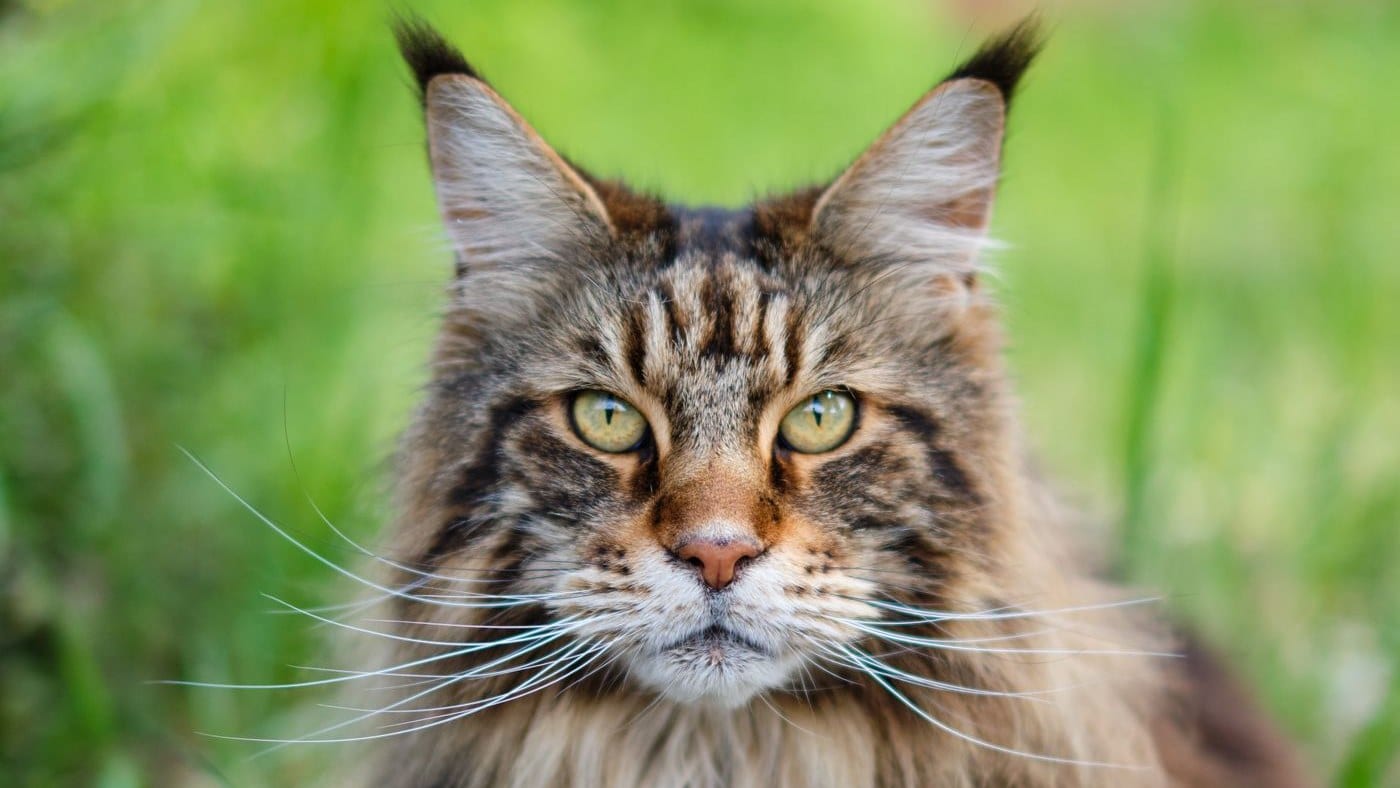
- Coat: semi-long and uneven — shorter over the back, longer on the flanks and belly; a dense ruff and a bushy tail
- Ears: large, set high, with tufts inside and often with lynx tips
- Paws: large, with hair between the toes — natural snowshoes
- Colour: most colours and patterns are accepted except chocolate, cinnamon and the colours derived from Siamese pointing
- Lifespan: usually 10–15 years
It matures slowly. Full size and head shape arrive only at three or four years old — until then it looks like a long-legged kitten that everything is too big for.
Temperament and environment
The Maine Coon is calmer than the oriental breeds, but it is not lazy. It likes to fetch, it opens doors, and it treats a running tap as entertainment.
It will tolerate being alone for a while but does not enjoy it — in a home that is empty all day, two cats are the better answer.
Coat care
Brush two or three times a week, more often when moulting. The semi-long coat with its undercoat mats mainly behind the ears, in the armpits, on the flanks and under the tail.
A mat is not pulled out by force — it hurts, and the cat will refuse grooming from then on. It is cut out, or removed by a professional.
The big furry paws pick up snow in winter; trimming the hair between the pads helps.
Feeding
An adult needs roughly 70–100 g of dry food a day depending on weight, or the equivalent in wet food. A big cat eats more — but the ratio to body weight is the same as in any cat, so the idea that a big cat can eat as much as it likes is simply wrong.
A growing kitten needs kitten food for longer than in small breeds: the Maine Coon grows until three, and the energy and protein have to last that whole time.
Common health problems
- Hypertrophic cardiomyopathy (HCM) — thickening of the heart muscle. An inherited mutation is described in the breed and a DNA test exists; breeding cats should also have a heart scan.
- Spinal muscular atrophy (SMA) — inherited, showing as an unsteady gait in young cats. A DNA test exists.
- Hip dysplasia — unusual in cats, but it occurs in this large breed.
- Polycystic kidney disease (PKD) — less common than in Persians, but tested for.
- Hairballs during moulting.
In no other cat breed does it pay off more to ask the breeder about testing. HCM and SMA can be excluded from a blood sample, and a good breeder shows the results unprompted.
This is not a diagnostic guide. A cat breathing with its mouth open, staggering or suddenly unwilling to walk needs a vet straight away.
Anything else to consider
A big cat means everything bigger: litter tray, scratching post, carrier and food ration. A standard cat carrier is too small for an adult male, and people usually discover that on the way to the vet.
And expect hair. The Maine Coon sheds all year round, and heavily during the moult.
Want one?
213 kennels here breed it. Each one has a contact and a link to its page.
Who breeds this
- ALEKEK*PLWrocław, Poland
- Alfonsina y el marDinkelbühl, Germany
- Amor Shell YukiKarlsruhe, Germany
- Ananda IgmuGrävenwiesbach, Germany
- ANGELCAT.PLPoland
- Ariel-MariBerlin, Germany
- AT*Sandstorm´s Maine CoonBrunn am Gebirge, Austria
- Auda's Maine CoonsWien, Austria
- aus dem NachtwunschSchönenberg-Kübelberg, Germany
- aus SchorfheideSchorfheide OT Finowfurt, Germany
- Bast CatsMannheim, Germany
- Bastet`s ChildBergheim, Germany
- BATI STELLA*PLAleksandrów Kujawski, Poland
- beautiful JUGAOberkirch, Germany
- Benna's CastleLindenberg, Germany
- BETI GRAŻKA*PLSzczekociny, Poland
- betreibe ich als reines Hobby und mit viel Liebe und EngagementKäbschütztal OT Löthain, Germany
- BIANKA’S PLACE*PLMarki, Poland
- BISCUIT AGAT*PLCzłuchów, Poland
- BLACK ASTER*PLBiałystok, Poland
- Black Smoker'sAttendorn, Germany
- Blanket'sAhrensbök, Germany
- BLAZING STAR*PLRadzymin, Poland
- BLUE MOONPoland
- bluetowncatsMarburg, Germany
- BohnenblüteBerlin, Germany
- BRubbeysLimbach-Oberfrohna, Germany
- Carpe DiemBreklum, Germany
- Casse-couBerlin, Germany
- Champion meines Herzen'sBerlin, Germany
- CHIDOGSLOVEPoland
- COLORFUL LIFE*PLŁęczyca, Poland
- comainelly mainecoonsJüchen, Germany
- COON'S KINGDOMPoland
- Coonie`s vom LotterbachWadern-Krettnich, Germany
- Cordes CoonNeustadt, Germany
- Crazy Arber´sBodenmais, Germany
- curious coonsHanau, Germany
- DA VINCIPoland
- Dangerstone'sNiederhausen, Germany
- de MadakeLaupheim, Germany
- De Roissy RoyalWien, Austria
- DiamondcooniesDietenhofen, Germany
- die Wilden 13Hannover, Germany
- DOLCZE BANDA*PLOsiny, Poland
- DOM FUTRZAKÓW*PLWarszawa, Poland
- DWÓR CARSKIBolesławiec, Poland
- ELITA SYSIPoland
- Enchanted Willow'sKarlsruhe, Germany
- EURO KASZMIR*PLToruń, Poland
- EWJATAR*PLSłupno, Poland
- FancycoonsWeißkirchen, Austria
- FLUFFY HUDSON BAY*PLPoland
- Folco'sBarßel, Germany
- Förchenwald'sSchongau, Germany
- from Dreamland CircusAmpfing E-Mail Homepage, Germany
- from Feloidea CarnivoraTrier, Germany
- from Mejor AmigaMetzingen, Germany
- FUTRZANA ZGRAJA*PLChełmża, Poland
- Giant Bear´sBassum, Germany
- GIANTCATS Castle*UAHackenbuch, Austria
- Goldenson'sKlingenbrunn, Germany
- GWIAZDA NOCY*PLŁódź, Poland
- HanariseNürnberg, Germany
- Hauffel PuffFleisbach, Germany
- HIPKOWO*PLHipolitów, Poland
- ILOWER*PLGalewice, Poland
- Imperial Cat HouseWanzleben-Börde, Germany
- JAGAGAGAPoland
- JeriCoka'sWiesloch-Baiertal, Germany
- JOANNA 3001.PLPoland
- JujuliciousEggenthal, Germany
- JUSTYNY MIAU*PLŻyrardów, Poland
- KAJKUNOWO*PLNieciszów, Poland
- KATE-KATS.PLPoland
- KITYGANG.PLPoland
- KönigsglanzRegensburg, Germany
- KRÓLESTWO FUTRA*PLPłock, Poland
- KRUSZYNKA*PLOlszyna, Poland
- KULECZKAPoland
- LAWENDOWE ZACISZEPoland
- Le MelinTornesch, Germany
- LILY KATSPoland
- LindörferBergtheim, Germany
- ŁOBEZCITY*PLŁobez, Poland
- LOVELY FAIRY*PLLublin, Poland
- LuchsrudelBogen, Germany
- MAINE COON NAD STAWAMIPoland
- Maine Coon of GajachSpittal, Austria
- Maine Coons von WolfsbrunnHollabrunn, Austria
- Maines Wildcat´sSchwabach, Germany
- Maison d' AmariaWendelstein, Germany
- MamasHeineCattyHersbruck, Germany
- Mambo Coon'sGladbeck, Germany
- MandersWolfenbüttel, Germany
- MAZURSKA SFORAPoland
- Meadowheart Maine CoonsMünster, Germany
- MiokarouNettetal, Germany
- MITHRIM*PLEmów, Poland
- NAMIKO’S WORLD*PLNowy Tomyśl, Poland
Showing the first hundred. The rest are in the breeder directory.
Breeders by region
The number shows how many breeders in the region keep this breed.
- Bayern (Germany)20
- Nordrhein-Westfalen (Germany)17
- Baden-Württemberg (Germany)14
- mazowieckie (Poland)12
- Niedersachsen (Germany)10
- Rheinland-Pfalz (Germany)8
- dolnośląskie (Poland)7
- Hessen (Germany)6
- kujawsko-pomorskie (Poland)6
- Schleswig-Holstein (Germany)6
- Berlin (Germany)5
- pomorskie (Poland)5
- śląskie (Poland)5
- zachodniopomorskie (Poland)5
- lubelskie (Poland)4
- Niederösterreich (Austria)3
- opolskie (Poland)3
- Sachsen (Germany)3
- wielkopolskie (Poland)3
- lubuskie (Poland)2
Breeders of this breed also keep
From the blog
- How to report animal crueltyA dog on a short chain with no water. A cat shut in an empty flat. Most people see something like this once and do not know who to call — and by the time they find out, they have talked themselves out of it. This guide is here so that does not happen.
- Adopting from a shelter: how it really worksFrom the first enquiry to the first week at home. Why the shelter asks so many questions, what a home check is for, and what to expect in the first three weeks.
- What the first year with a dog or cat really costsEveryone budgets for food and a bed. What breaks the budget is one item nobody expects — and costs that are not measured in money at all.