Bernese Mountain Dog
A calm giant with a mild temperament, well suited to a family and to life with a garden. There are two things to reckon with in advance, though: it needs to be with people, and it does not live long — often only seven to nine years.
- Species:
- dog
- Origin:
- Switzerland
- Breeders here:
- 216
Who it suits
A family with space and with time. The Bernese is steady, patient with children and reserved with strangers without being aggressive. It is not a guard dog in the real sense — it announces, but it does not attack.
It originally pulled cheese carts and watched over the farm. What remains from that is strength, calm and a strong bond to the family: it wants to be where the people are, and it suffers in a kennel in the garden.
It does not suit a small flat, hot weather or an owner who is out all day. And it does not suit anyone who cannot live with hair — shedding in this breed is a year-round discipline.
What it looks like
- Height: dogs 64–70 cm, bitches 58–66 cm at the withers
- Weight: dogs 38–50 kg, bitches 36–48 kg
- Coat: long, glossy, slightly wavy, with a dense undercoat
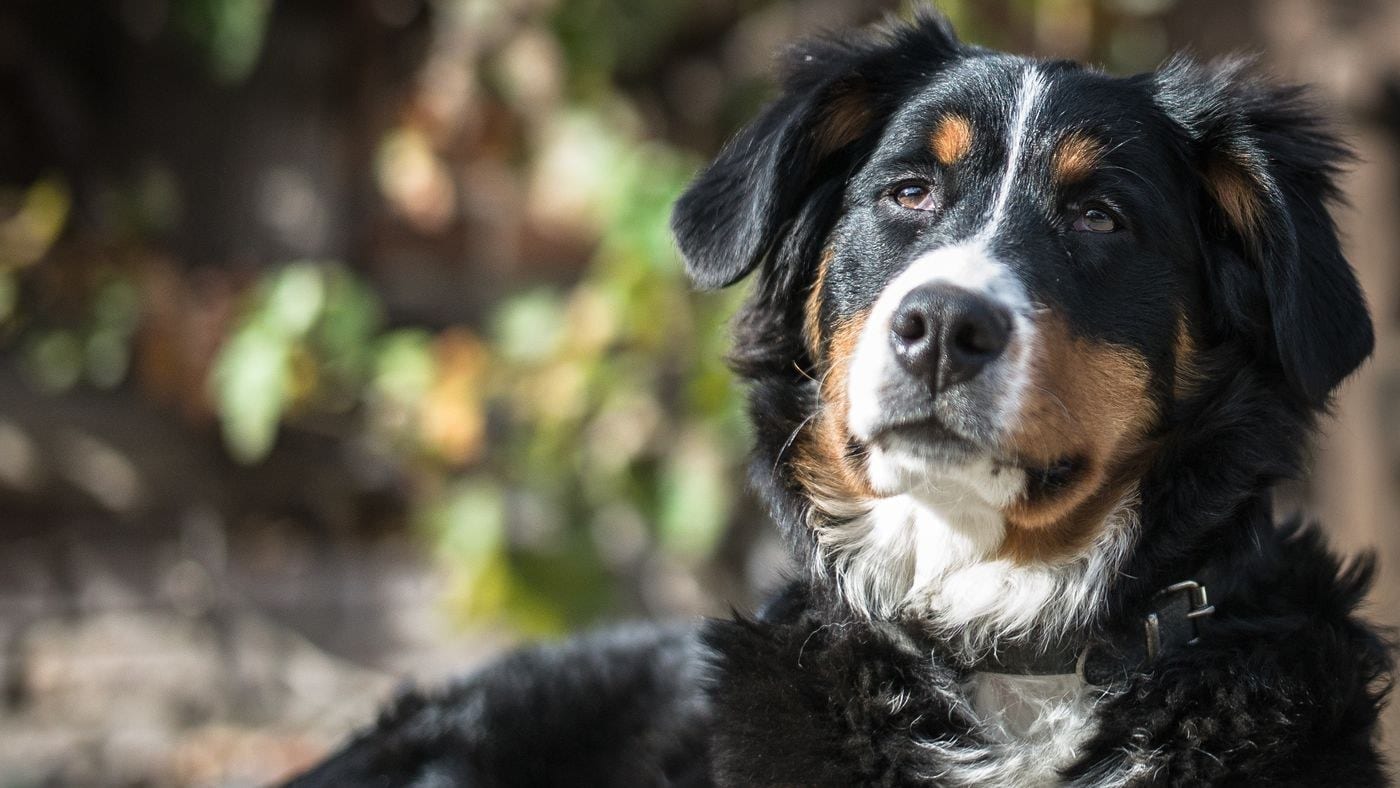
- Colour: always tricolour — black ground, rust markings over the eyes, on the cheeks and legs, with a white blaze, chest and feet
- Lifespan: usually 7–9 years; short even by the standards of large breeds
How much exercise it needs
An adult manages one to two hours a day at a steady pace. It is not a runner or an athlete — regular walking and mental work suit it.
With a puppy the main rule is not to overload it. A large breed grows for a long time, and the joints are still closing at eighteen months. Stairs, long runs and jumping in the first year have permanent consequences.
Do not walk it in the heat. A dense double coat and black colour mean it overheats quickly. In summer, walk early and late, with shade and water always available.
Coat care
Brush two or three times a week, daily while moulting. Mats form behind the ears, in the armpits and on the hind legs.
The coat is not clipped. A double coat protects against heat as much as against cold; a clipped dog overheats more, not less, and the undercoat does not grow back properly after shearing.
Training and the first months
- Train it while it weighs twenty kilos. With a forty-kilo dog there is no longer the physical strength to enforce anything by pulling.
- Gentle methods. The breed is sensitive and responds to harshness by shutting down, not by obeying.
- Socialisation from the start — the Bernese is naturally reserved with strangers, and without early experience it often becomes an insecure dog.
Feeding
An adult eats roughly 400–600 g of dry food a day in two meals. For a puppy, large-breed food matters — it has less energy and calcium, because faster growth is not better growth.
Keep the dog quiet for at least an hour after eating. Gastric torsion threatens every large deep-chested breed, and the Bernese is one of them.
Common health problems
There is no way to soften this. The Bernese Mountain Dog is among the shortest-lived breeds, and the main reason is cancer.
- Histiocytic sarcoma — a malignant tumour, markedly more common in this breed than in others. It is the leading cause of death in Bernese.
- Hip and elbow dysplasia — inherited; the parents must have scored radiographs.
- Cruciate ligament disease in the knee, common in heavy breeds.
- Degenerative myelopathy — progressive paralysis of the hindquarters in later life.
- Gastric torsion — an acute, life-threatening emergency.
- Kidney disease; an inherited form occurs in the breed.
This is not a diagnostic guide. If you feel a lump on the dog or it starts limping, that belongs at the vet now, not in a month.
Anything else to consider
It is better to know about the short lifespan in advance. Seven to nine years is genuinely little for a dog that takes two years to mature — but it is a truth a good breeder will tell you unprompted.
Ask about how long the dogs in previous litters lived and what they died of. A breeder who knows and says is doing the job honestly.
Want one?
216 kennels here breed it. Each one has a contact and a link to its page.
Who breeds this
- .. van de kleine hondKerpen, Germany
- ... aus dem FehnlandSaterland, Germany
- ... from blue moonFraureuth, Germany
- ... of Jasmin's sunny hillWölsendorf bei Schwarzach, Germany
- ... vom AlsbachtalDuisburg, Germany
- ... vom BärenseeHolzappel, Germany
- ... vom HaubachparadiesHerbstadt, Germany
- … vom Home of Sweet PetitesWertheim, Germany
- ... vom SilberseeNiederzier, Germany
- ... vom StrohgäuGerlingen, Germany
- ... vom TannenhölzchenSeegebiet Mansfelder Land, Germany
- ... vom Teck BlickOberboihingen, Germany
- ... vom WerntalWerneck, Germany
- ... von den AhsewiesenWelver-Borgeln, Germany
- ... von den BolonkapfotenOerlenbach, Germany
- ... von den FrankenbärenNeuenmarkt, Germany
- ... von den HonigperlenGerlingen, Germany
- ... von der BlumenstadtStraelen, Germany
- ... von der KreuzbergquelleMeiningen, Germany
- ... von der OsterbekPritzier OT Schwechow, Germany
- ... von HamletMilda, Germany
- ... von Schloß EbenhausenOerlenbach, Germany
- ...vom Home of HarmonyDietenhofen, Germany
- ...von den Grubenwehr ZwergenFrechen, Germany
- Achtern FellnHasloh, Germany
- AllerdeichHäuslingen, Germany
- AlpellasRadevormwald, Germany
- AlturaRzeszów, Poland
- am Deich vom Rysumer RunddorfKrummhörn / Rysum, Germany
- Angel of my HeartHerdecke, Germany
- ANIELSKA FARMANowogard, Poland
- ANIOŁKI SKRZYDLATEKuryłówka, Poland
- Anirys Team FCIPoznań, Poland
- AueteichAuetal, Germany
- aus dem Heimlinger TalMerzig, Germany
- BadstubenfarmNeubulach, Germany
- BARCICKA SFORAPoland
- BärengartenLandsberg, Germany
- BasiadanWiry, Poland
- BastenbergBestwig, Germany
- BERNEŃCZYKI U WIOLETTYPoland
- Berneńska DolinaBydgoszcz, Poland
- BERNEŃSKA OSTOJAPoland
- BERNEŃSKA RODZINAPoland
- BERNEŃSKI ŚWIATPoland
- BERNEŃSKI ZAKĄTEKPoland
- Berneńskie Marzenia FCIBorowno, Poland
- BERNEŃSKIE PIESZCZOCHYPoland
- BERNEŃSKIE SOKOLESokole, Poland
- Berner Sennenhunde von WiesmadernUlrichsberg, Austria
- BERNIQUEKarniewo, Poland
- BERNISIOWY ŚWIATPoland
- BERNMISIOWA ZAGRODAPoland
- BETISPoland
- BeuchenbergEisenberg, Germany
- BonnaueLampertheim, Germany
- CHATA BERNIEGOPoland
- CheruskerquellenHalle (Westf.), Germany
- CIEPŁY ZAKĄTEKPoland
- CLEO MAJOWE ŁĄKITarnów, Poland
- Coswiger ElbaueCoswig, Germany
- de vico FortianaeSt. Wendel-Winterbach, Germany
- DIAMENTOWE BERNEŃCZYKIPoland
- DiepmannsbachtalRemscheid, Germany
- DIONELPoland
- DOLINA DAISYPoland
- Drei DiamantenQuerfurt, Germany
- ErtheneburgSchnakenbek, Germany
- EssbachtalRinggau, Germany
- FANTA DREAMSPoland
- Fehntjer DeepGroßefehn, Germany
- Fiery Bernaes FCIBydgoszcz, Poland
- from Green Kalej FCIKalej, Poland
- GABRYSIOWY RAJPoland
- Gandziołkowe Wzgórze FCIJagatowo, Poland
- GANG BLAŹNIAKAPoland
- GENESISPoland
- GrenzsteigFriedrichskoog, Germany
- HankenüllBorgholzhausen, Germany
- Hof RiesenbergAmstetten, Austria
- Holter HöheCuxhaven, Germany
- House of Phelan...Bobeck, Germany
- Jak z Obrazka FCIPoland
- JakobshöheKranichfeld, Germany
- Jesienna Sonata FCIPoland
- JUŚCIEŃSKIE WZGÓRZEPoland
- Kaarzer HofKaarz, Germany
- KadettenhofAlsleben, Germany
- KAHORIPoland
- KALBAPoland
- Kamień Milowy FCIBełchatów, Poland
- KASZUBSKA DOLINAPoland
- Kerstin AßlaberFriesach, Austria
- KOSISKIE RANCZOPoland
- KOZDRYKOWE MISIAKIPoland
- Królewskie Ranczo FCIKalisz, Poland
- KukesburgBad Münder, Germany
- LAV-BERNESPoland
- LehrpfadGnarrenburg, Germany
- Leśna MagiaSosnówka, Poland
Showing the first hundred. The rest are in the breeder directory.
Breeders by region
The number shows how many breeders in the region keep this breed.
- Nordrhein-Westfalen (Germany)29
- Niedersachsen (Germany)16
- mazowieckie (Poland)14
- Bayern (Germany)13
- Baden-Württemberg (Germany)11
- Hessen (Germany)11
- Thüringen (Germany)9
- wielkopolskie (Poland)9
- łódzkie (Poland)8
- Schleswig-Holstein (Germany)8
- Rheinland-Pfalz (Germany)7
- śląskie (Poland)7
- Sachsen (Germany)6
- Sachsen-Anhalt (Germany)6
- Brandenburg (Germany)5
- dolnośląskie (Poland)5
- małopolskie (Poland)5
- pomorskie (Poland)5
- zachodniopomorskie (Poland)5
- lubelskie (Poland)4
Breeders of this breed also keep
From the blog
- How to report animal crueltyA dog on a short chain with no water. A cat shut in an empty flat. Most people see something like this once and do not know who to call — and by the time they find out, they have talked themselves out of it. This guide is here so that does not happen.
- Adopting from a shelter: how it really worksFrom the first enquiry to the first week at home. Why the shelter asks so many questions, what a home check is for, and what to expect in the first three weeks.
- What the first year with a dog or cat really costsEveryone budgets for food and a bed. What breaks the budget is one item nobody expects — and costs that are not measured in money at all.