Australian Shepherd
Clever, fast and eager to work — a dog that learns anything, which is why it is a favourite in dog sports. It is not a fit for a family that will do nothing with it: an unemployed Aussie finds its own job, and that job is usually herding and chasing everything that moves.
- Species:
- dog
- Origin:
- United States
- Breeders here:
- 82
Who it suits
An active person who wants to train or compete with a dog. The Australian Shepherd learns remarkably fast, is willing to work with people and is near the top in agility, disc and obedience.
Despite the name it does not come from Australia — it was developed in the United States by Basque shepherds who arrived there via Australia. It is a true herding dog with everything that implies.
It does not suit life as a quiet family dog in a flat. An unemployed Aussie starts guarding the door and chasing bicycles, cars and running children — that is not mischief, it is herding instinct without sheep.
It tends to be reserved with strangers; without good socialisation it easily becomes a dog that barks at every visitor.
What it looks like
- Height: dogs 51–58 cm, bitches 46–53 cm at the withers
- Weight: dogs 25–32 kg, bitches 18–25 kg
- Coat: medium length with an undercoat, longer on the neck and hind legs
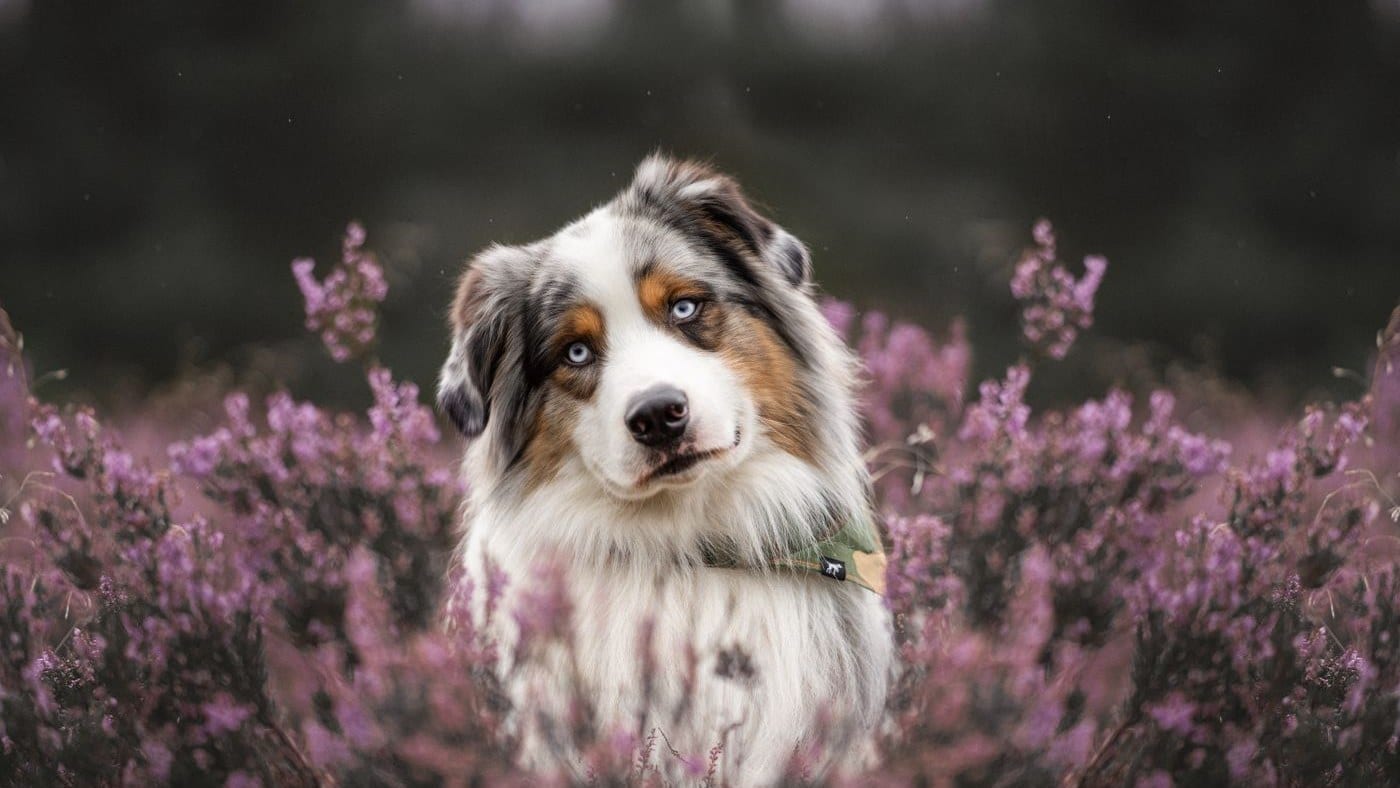
- Colour: blue merle, red merle, black and red — all with white and copper markings
- Eyes: brown, blue, amber or odd-eyed; blue eyes are common in merles
- Lifespan: usually 12–15 years
Merle is a standard colour in this breed, unlike breeds where it was introduced later. There is one hard rule, though: two merles must never be bred together. Puppies from such a mating are often deaf, blind or both. A breeder offering a double merle as something rare is doing something that should not be done.
How much exercise it needs
At least two hours a day, with at least a third of that being mental work. Thinking tires an Aussie far faster than running.
Running alone will not settle it — it only builds fitness, so next time the dog needs more. Trick training, scent work, obedience or herding is what it is looking for.
Do not overload a puppy in its first year: long runs beside a bike and agility jumps belong to an adult dog.
Training and the first months
- Socialisation before four months is decisive in this breed. The Aussie is naturally watchful, and without early experience it often becomes an insecure dog that deals with fear by using its voice.
- Chasing has to be redirected from the start. A running child, a cyclist or a cat triggers the herding pattern — the dog tries to circle and stop them. The answer is a substitute job, not punishment.
- It also learns what you are not teaching it. A clever dog quickly works out that barking gets results.
Feeding and the MDR1 gene
An adult eats roughly 250–400 g of dry food a day in two meals, depending on workload.
And now the most important thing every Aussie owner should know. A mutation of the MDR1 gene is widespread in the breed, which stops the dog clearing certain common drugs from the brain — some wormers, some antiparasitics and some anti-diarrhoeal medicines. In a susceptible dog a normal dose can cause serious harm or death.
There is a simple DNA test from blood or a cheek swab. The result belongs in the dog's medical records and should be known to every vet who gives it anything. A good breeder will show the parents' results without being asked.
Common health problems
- The MDR1 mutation — drug sensitivity. The test is cheap and essential.
- Hip and elbow dysplasia — the parents must have scored radiographs.
- Inherited eye disease — coloboma, cataract, progressive retinal atrophy. In merles the eyes are always examined.
- Epilepsy — it occurs in the breed.
- Deafness — the risk rises sharply from a merle-to-merle mating.
This is not a diagnostic guide. But with MDR1 there is one practical rule: before anyone gives this dog anything, they should see that result.
Anything else to consider
An Aussie sheds a lot, and twice a year it sheds enormously. The medium coat with its undercoat is brushed twice a week, and daily while moulting.
One last thing: this is a breed in high demand right now. Wherever demand rises, breeders without health testing appear. With an Australian Shepherd it pays to ask about MDR1, hips and eyes before asking about price.
Want one?
82 kennels here breed it. Each one has a contact and a link to its page.
Who breeds this
- ...vom SonnenfeldMunderfing, Austria
- * CC-Aussies of Rosecreek *Rosbach vor der Höhe / Nähe Frankfurt am Main, Germany
- Aluna AussiesNiederdürenbach, Germany
- Amazing MomentsReilingen, Germany
- AranarthDörverden, Germany
- Australian Shepherd the Gently BodyguardAustria
- BowtruckelsScholen, Germany
- Bright StarlightsHennef (Sieg), Germany
- Casa AmbienteDannstadt, Germany
- Charming SoulbanditsNiederkrüchten, Germany
- Colour JewelsBurgwedel, Germany
- Cool-PawsLohmar, Germany
- Country-House-AussiesWaldbrunn-Lahr ( Westerwald), Germany
- CreekvalleyHeiligkreuzsteinach, Germany
- Crown TownSiegen, Germany
- Danube-lowland-AussiesBreitenstein, Austria
- Deerland’sMeißendorf, Germany
- Dreams of Lower SaxonyCelle, Germany
- Elements of NatureWetter, Germany
- FenyxNiederkrüchten, Germany
- Flaming AngelsKönigsbach-Stein, Germany
- from Shorty’s ParadiseWakendorf I, Germany
- from the House of Adamczak (FCI)Bydgoszcz, Poland
- Greenheart ShepherdsElleben, Germany
- Heart & BrainJülich, Germany
- Heavenly StrikerWinsen/Luhe, Germany
- High-MountainPörnbach, Germany
- Hot’n’Cool PawsViersen, Germany
- Incredible OMG SportysBonn, Germany
- Ivy GardenReken, Germany
- Just blue Ivy’sHirzenhain, Germany
- Laughing Drover’sXanten, Germany
- Little Aussie StarsLauenburg, Germany
- Live Wire’sWuppertal, Germany
- Magic Fireball’sDuisburg, Germany
- Magic New Generation’sRheurdt, Germany
- March Horse N Glitter DogsLeimersheim, Germany
- MarubaBreitingen, Germany
- MC-AussiesPleitersheim, Germany
- Mind Over MatterGelsenkirchen, Germany
- My Luso DreamEppelborn, Germany
- New Hope without LimitsNeumünster, Germany
- of Magnificent SoulGrasberg, Germany
- of PunangaAltertheim, Germany
- of the evening sunSchönewalde, Germany
- Owczarek australijskiBydgoszcz, Poland
- Passion & MagicLüdenscheid, Germany
- Poldeczki FCIPoland
- Pure Precious NextOhlsbach, Germany
- Randalenbande’sTroisdorf, Germany
- Relight My FireSelm, Germany
- River GardenGeisenfeld, Germany
- Rock’n StormLeibertingen, Germany
- Roman cityXanten, Germany
- Rosalia Aussies...Forchtenstein, Austria
- Savanna DryErkelenz, Germany
- Secret SoulStadtallendorf, Germany
- Sensational Touch (VDH)Erkelenz, Germany
- Shadow Valley AussiesKainach bei Voitsberg, Austria
- SILVER ARIAPoland
- Smart And SmilingIngolstadt, Germany
- Smile of SunshineEspelkamp, Germany
- Soul of HossBad Laasphe, Germany
- SoulwindSüdharz OT Rottleberode, Germany
- SteinhöglBurgkirchen, Austria
- The Running BumblebeeAcholshausen, Germany
- Time for DreamsRehlingen, Germany
- True FacesKirchardt, Germany
- TrulyawesomeKirchardt, Germany
- Twin Falls CreekFrankfurt/Main, Germany
- Uschi RaderPrellenkirchen, Austria
- vom HoerstenhofWestoverledingen, Germany
- vom MoorschatzStemwede, Germany
- Vom Südlichen OrakelDieburg, Germany
- von AltwartenburgSeewalchen/Attersee, Austria
- Von den Freigeistern (VDH)Waltrop, Germany
- von den SauerlandpfotenNeuenrade, Germany
- von PfotenstolzReher, Germany
- WeatherstoneGeisfeld, Germany
- WESTWOODDREAMWahlrod, Germany
- Wild Divine’sMoers, Germany
- WookaliSimonswald, Germany
Breeders by region
The number shows how many breeders in the region keep this breed.
- Nordrhein-Westfalen (Germany)25
- Baden-Württemberg (Germany)9
- Niedersachsen (Germany)8
- Rheinland-Pfalz (Germany)5
- Bayern (Germany)4
- Hessen (Germany)4
- Oberösterreich (Austria)3
- Schleswig-Holstein (Germany)3
- Niederösterreich (Austria)2
- Brandenburg (Germany)1
- Burgenland (Austria)1
- mazowieckie (Poland)1
- Saarland (Germany)1
- Steiermark (Austria)1
- Thüringen (Germany)1
Breeders of this breed also keep
From the blog
- How to report animal crueltyA dog on a short chain with no water. A cat shut in an empty flat. Most people see something like this once and do not know who to call — and by the time they find out, they have talked themselves out of it. This guide is here so that does not happen.
- Adopting from a shelter: how it really worksFrom the first enquiry to the first week at home. Why the shelter asks so many questions, what a home check is for, and what to expect in the first three weeks.
- What the first year with a dog or cat really costsEveryone budgets for food and a bed. What breaks the budget is one item nobody expects — and costs that are not measured in money at all.