Dwarf Lop
The most popular pet rabbit in Europe — calm, friendly and with the dropped ears people pick it for. But that short head and that folded ear bring two problems you have to keep in mind for the animal's whole life.
- Species:
- rabbit
- Origin:
- Germany
- Breeders here:
- 15
Who it suits
A family that wants a rabbit as a proper pet, not as an ornament in a cage. The Dwarf Lop is one of the calmer and more trusting breeds — unlike the tiny dwarf rabbits it tends to be less flighty and gets used to being handled more easily.
It is social. It should not live alone. A rabbit is a herd animal, and a single rabbit in a flat is a lonely rabbit; a neutered pair is the right arrangement.
It does not suit small children as a pet to carry around. Rabbits dislike being lifted off the ground — up in the air they feel exposed, and a kick can break their spine. You play with a rabbit on the floor, not in your arms.
What it looks like
- Weight: under the British Rabbit Council standard the Dwarf Lop weighs 1.93–2.38 kg. The continental small lop that carries the same everyday name — the Zwergwidder or zakrslý beran — is lighter, 1.5–1.9 kg, and in the UK the nearest equivalent is the Miniature Lop at up to 1.6 kg. Lop names differ between countries more than in almost any other rabbit, so always ask for the weight of the parents rather than relying on the name.
- Body: short, stocky, with a broad chest
- Head: broad, strongly domed, with a short muzzle
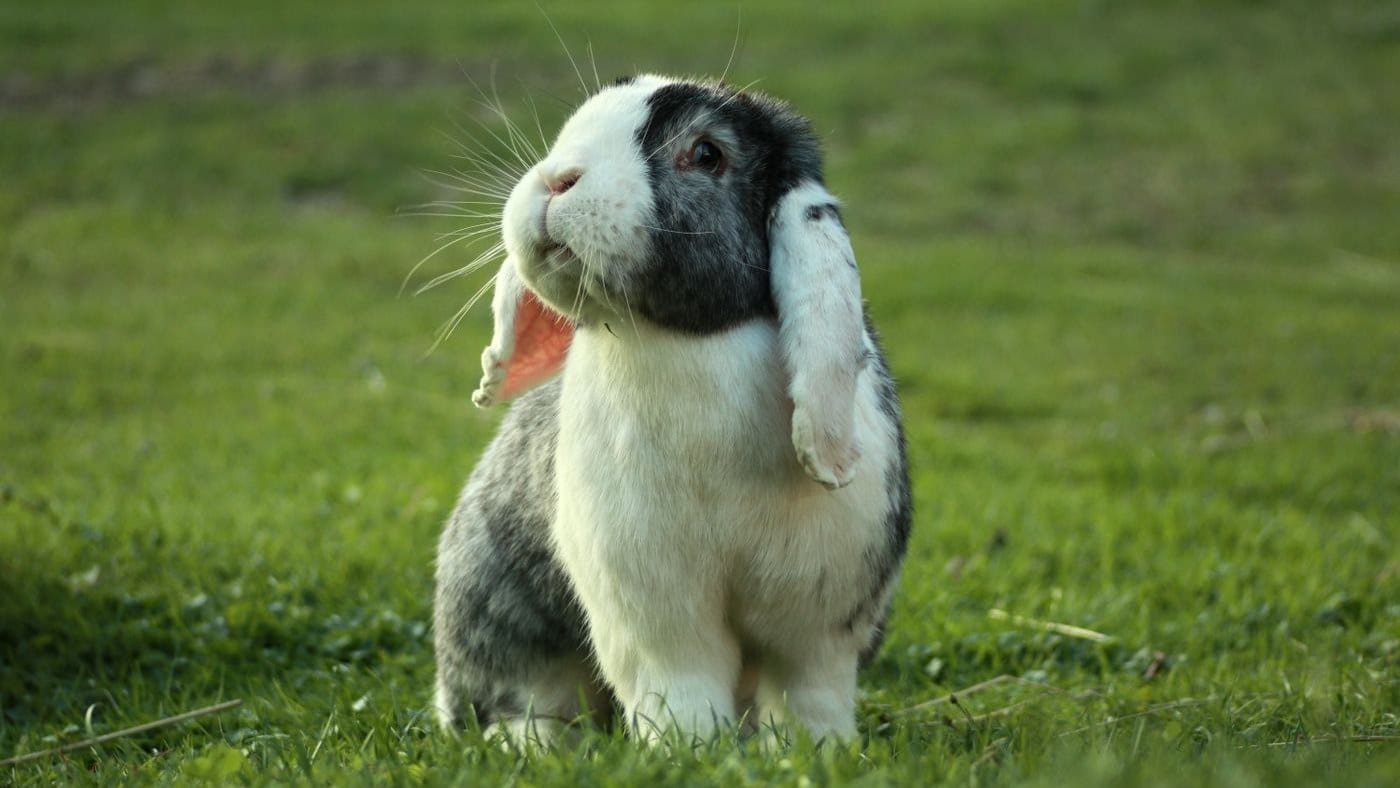
- Ears: hanging down each side of the head, with a visible crown of cartilage between them — the feature that identifies the breed
- Coat: dense, of medium length
- Colour: almost every colour is recognised — agouti, black, blue, butterfly, broken and silvered patterns
- Lifespan: with good care 8–12 years
Housing — the commonest mistake
A pet-shop cage is a bed for a rabbit, not a home. A rabbit needs room to break into a run and to sit up on its hind legs, and no ordinary cage allows that.
- At least 3 m² of free floor space for a pair, ideally a pen or a whole rabbit-proofed room.
- Several hours of free movement a day, even when the pen is large.
- A hiding place — a box or a tunnel. Without one the rabbit lives under stress.
- Non-slip flooring. Smooth vinyl damages a rabbit's joints.
- A litter tray with hay — rabbits learn to use one more easily than people expect.
- Protected cables. Anything within reach will be chewed.
An outdoor hutch is fine if it is insulated, dry and protected from sun and predators. Heat kills a rabbit faster than frost — above 25 °C it needs cooling.
Feeding
This is where most mistakes are made, and the mistake shows up in the teeth and in the gut.
- Hay is 80 % of the diet and must be available at all times. Not only for digestion — chewing hay wears down teeth that grow for the whole of the rabbit's life.
- Fresh greens and herbs daily: dandelion, plantain, parsley, carrot tops, celery, leaf lettuce (not iceberg).
- Pellets only in small amounts — about a tablespoon a day, and only good ones, without coloured pieces or cereal.
- Water in a bowl, not only a bottle. Rabbits drink more from a bowl.
- Fruit only as an occasional treat. Sugar does rabbits no good.
- Never: bread, maize, pulses, dairy, or the so-called treats with honey or yoghurt.
Any change of food is made gradually, over several days.
Routine care
- Coat — brush weekly, more often when moulting. A rabbit grooms itself like a cat but cannot vomit, so swallowed fur stays in the gut.
- Claws — trim roughly every 6–8 weeks.
- Ears — in a lop, check them regularly; see below.
- Rear end — check daily that it is clean and dry. In warm weather flies lay eggs on soiled fur and the maggots burrow into the rabbit within a single day. It is life-threatening.
Common health problems
Two of these follow directly from the way the breed is built. That is not a reason to avoid a lop — it is a reason to know about them in advance.
- Dental disease — a shortened head means less room for teeth that grow all life long. A bad bite leads to overgrowth, sharp spurs and painful injuries to the tongue. It shows as drooling, weight loss and refusing hard food. Plenty of hay is the best prevention, but it will not fix an inherited malocclusion.
- Ear infections — a folded ear does not ventilate, wax builds up and cannot drain. It shows as scratching, a head tilt and a smell. In a lop the ears are checked regularly; in erect-eared breeds this is rarely an issue.
- Gut stasis — the rabbit stops eating and stops passing droppings. This is an emergency: a rabbit that has not eaten for 12 hours needs a vet the same day.
- Myxomatosis and rabbit haemorrhagic disease — both are fatal and both are vaccinated against, even in an animal that never goes outside. They are carried by biting insects and can be brought in on shoes.
- Encephalitozoon cuniculi — a parasite affecting brain and kidneys; it shows as a head tilt or paralysis.
- Coccidiosis — common in young rabbits, shows as diarrhoea.
What to ask the breeder: what the parents' bite looks like, whether either of them has ever had overgrown teeth, and whether the young are vaccinated. Dental malocclusion is inherited, and you can see it before you pay for it.
This is not a diagnostic guide. A rabbit that is not eating, not passing droppings, tilting its head or drooling needs a vet immediately — and preferably one who sees small mammals regularly.
Anything else to consider
Neutering is worth it. In does it greatly reduces the risk of uterine cancer, which is high in entire females; in bucks it reduces spraying and aggression. It is also what makes a pair live together peacefully.
And the thing people underestimate: a rabbit lives eight to twelve years, and treating one usually costs more than treating a cat, because not every vet works with rabbits. Find your nearest exotics or small-mammal practice before you need it.
Want one?
15 kennels here breed it. Each one has a contact and a link to its page.
Who breeds this
- Albert HeindlSalzweg, Germany
- Bernd PolsterPegnitz, Germany
- Franz GrafNittenau, Germany
- Franziska FurtwenglerFürth, Germany
- Jan KurzböckWegscheid, Germany
- Karll-Heinz LeirichSpiegelau, Germany
- Lena AckermannWolfratshausen, Germany
- Linda ReimWeihern/Paf, Germany
- Martin HeimgärtnerWald, Germany
- Nico FuchsManching, Germany
- Reinhard NeukamGoldkronach, Germany
- Reinhold HilburgerStörnstein, Germany
- Sabine ObermüllerAschau im Chiemgau, Germany
- Siegfried RödelGattendorf, Germany
- Stefan JohannMamming, Germany
Breeders by region
The number shows how many breeders in the region keep this breed.
Breeders of this breed also keep
From the blog
- How to report animal crueltyA dog on a short chain with no water. A cat shut in an empty flat. Most people see something like this once and do not know who to call — and by the time they find out, they have talked themselves out of it. This guide is here so that does not happen.
- Adopting from a shelter: how it really worksFrom the first enquiry to the first week at home. Why the shelter asks so many questions, what a home check is for, and what to expect in the first three weeks.
- What the first year with a dog or cat really costsEveryone budgets for food and a bed. What breaks the budget is one item nobody expects — and costs that are not measured in money at all.