Bengal
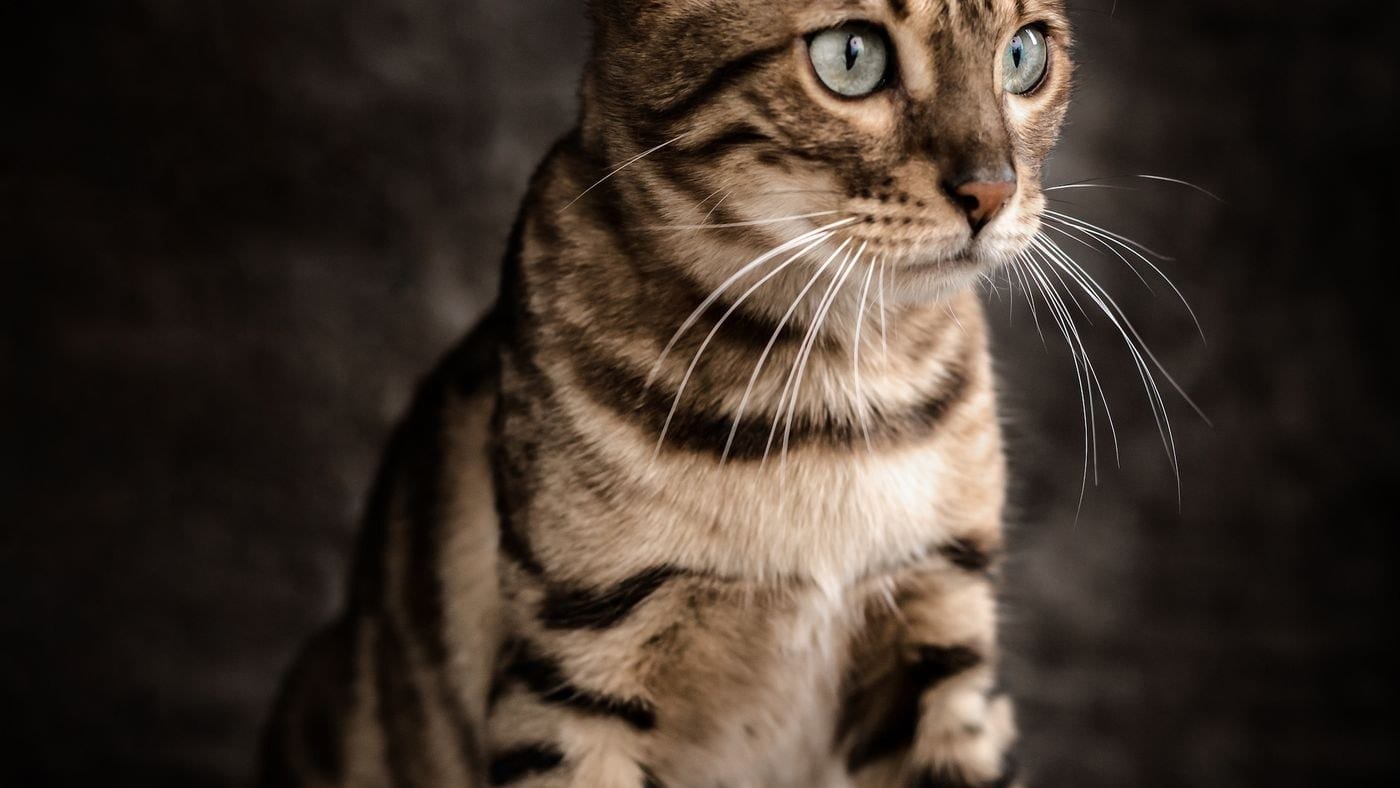
A cat that looks like a small leopard and behaves almost like a dog — it retrieves, walks on a lead and loves water. Above all, though, it is a very active animal: a Bengal in an empty flat will find its own entertainment, and the owner will not enjoy it.
- Species:
- cat
- Breeders here:
- 100
Who it suits
Someone who wants a cat with something going on. The Bengal is curious, clever and playful well into adulthood — it learns to retrieve, to walk in a harness and to open doors.
It came from crossing the domestic cat with the Asian leopard cat (Prionailurus bengalensis), a small wild cat. That is where both the markings and the temperament come from.
It does not suit a quiet household where a cat is expected to sleep on the sofa. The Bengal is noisier than most breeds, vocalises a great deal and demands attention.
Water does not frighten it — rather the opposite. The tap, the shower and the aquarium are all entertainment, and you should expect that.
Generations F1 to F4 — ask about this
Bengals are described by their generation from the wild ancestor:
- F1 — direct offspring of the wild cat
- F2, F3 — second and third generation
- F4 and beyond — from this generation the cat counts as fully domestic, and only these are recognised for breeding and for shows
Early-generation cats do not belong in a flat. They show stronger wild behaviour, tolerate handling less well, and in some countries they are subject to special rules. A breeder offering an F1 or F2 as a house pet is telling you a good deal about themselves.
What it looks like
- Weight: males 5–7 kg, females 3–5 kg
- Body: muscular, elongated, with longer hind legs — hence the prowling gait
- Coat: short, dense, unusually silky; in some cats it has a sheen known as glitter
- Markings: spotted (rosetted) or marbled; the contrast should be strong
- Colour: brown, snow and silver in several shades
- Lifespan: usually 12–16 years
How much stimulation it needs
This is the main issue with the breed. A Bengal needs vertical space, toys and interaction — not necessarily the outdoors, but definitely not an empty flat.
- High shelves and a solid scratching post it can climb.
- Puzzle feeders it has to work at — the hunting drive is strong and it is better directed than suppressed.
- A harness and walks are a realistic option; Bengals take to a lead more readily than most cats.
A bored cat of this breed makes itself heard: it sweeps things off tables, opens cupboards and runs about at night.
Feeding
An adult needs roughly 50–70 g of dry food a day or the equivalent in wet food. The Bengal is active, so obesity is less of a problem than in calmer breeds — which does not mean the food should not be measured.
As with all cats, wet food helps with fluid intake. The breed is described as having a more sensitive digestion, so any change of food is made gradually.
Common health problems
- Progressive retinal atrophy (PRA-b) — inherited loss of sight; there is a DNA test specific to Bengals.
- Pyruvate kinase deficiency (PK-def) — inherited anaemia, testable by DNA.
- Hypertrophic cardiomyopathy (HCM) — thickening of the heart muscle; breeding cats should have a heart scan.
- Flat-chested kittens — a ribcage defect in newborns that occurs in the breed.
- A more sensitive digestion, especially when food is changed.
Three specific DNA tests exist for Bengals and a good breeder has them. Ask about PRA-b, PK-def and the heart scan.
This is not a diagnostic guide. A cat losing weight, seeing poorly or breathing fast belongs at the vet.
Anything else to consider
The Bengal is loud. It does not miaow like an ordinary cat — it growls, yowls and makes itself very clearly heard. In a flat with thin walls that is something people discover afterwards.
One last practical note: this is a breed that can climb anywhere. Windows and balconies need netting before the cat comes home, not after.
Want one?
100 kennels here breed it. Each one has a contact and a link to its page.
Who breeds this
- Amy Imperial‘sZimmern E-Mail, Germany
- Aschberg-BengalsKirchstetten, Austria
- aus dem Harzer ZauberwaldGoslar, Germany
- aus der Stadt der TürmeRottweil, Germany
- aus der ZauberburgLoxstedt-Bexhövede, Germany
- aus OytermühleOyten, Germany
- BengaLila ParadiseBaden-Baden, Germany
- Bengals of Diamond BloomLünen, Germany
- BLONDASEK*PLLipce Reymontowskie, Poland
- Bojarkin´sSande, Germany
- Castle of CassandraLahr, Germany
- Cattery from OldesloeBad Oldesloe, Germany
- Cattery vom PeenetalBlesewitz, Germany
- Charming HuntersMünchen, Germany
- Christa WurzerMarkt Piesting, Austria
- Circle of BengalWeiden, Germany
- CuddlyfansKarlsruhe, Germany
- DarKalchemy*DEMühldorf am Inn, Germany
- De.Luna'sStoetze, Germany
- del BenaliraOftersheim, Germany
- der Rassekatze Bombay aus der Löwenstadt BraunschweigBraunschweig, Germany
- DressycatsGöttingen, Germany
- Dubaidancer'sDörzbach, Germany
- EMAUSPoland
- FairytaleSoulsMaria Neustift, Austria
- from River MagnificenceDiedorf, Germany
- Grafinger BengalenGrafing, Germany
- LAMPARCI RAJ*PLGdańsk, Poland
- LeopardendreamsLübeck, Germany
- LeopardenglanzBremen, Germany
- Little PhasercatDuderstadt, Germany
- MadeWithLoveGermany
- MagicSpotsSalzwedel, Germany
- Malia & Malou'sKonstanz, Germany
- MAŁY LAMPART*PLMałocice, Poland
- Mayer's JewelsHeidenheim a. d. Brenz, Germany
- MONIDWOREK*PLSosnowiec, Poland
- Moritzburger AuerwaldMoritzburg OT Auer, Germany
- MurilegusSchneegattern, Austria
- MyZeilEschborn, Germany
- of Darja' BrilliantTegernbach Gem. Rudelzhausen, Germany
- of Greenlight LegacyGermany
- of Happymoor*DEHenstedt-Ulzburg, Germany
- of IsaevDelmenhorst, Germany
- of Lila NeotopiaKarlsruhe, Germany
- of little Castle RiverBurgwedel, Germany
- of Marvelous ValleySottrum, Germany
- of SandalwoodRotenburg, Germany
- of Snow AddictionLünen, Germany
- of the UnisphereSchorndorf, Germany
- of triple LeopardsLoxstedt, Germany
- of WildpantherPeheim, Germany
- Ostenauer'sWillstät, Germany
- PRIME TIGRIS*PLPrzytyk, Poland
- PUCHOWE LOVE*PLRzeszów, Poland
- Quartier 84Leipzig, Germany
- Reina de la LunaBottrop, Germany
- RIO CUANGO*PLWarszawa, Poland
- ROSES PARADISE*PLTopólka, Poland
- SAUVAGELUXE BEN*PLWarszawa, Poland
- SeeBengalTrhemi*DEEngen, Germany
- Shaddow meets LightTraunstein, Germany
- SolneschkaWallerstein, Germany
- SoulmatebengalsPenzing, Germany
- SUGARLOAF*PLNowa Sól, Poland
- SunlightObhausen, Germany
- TenshiWangen, Germany
- Tigris EternaUnterföhring, Germany
- TinyJaguarsErbach, Germany
- true temptationVöhl, Germany
- True WildshineEssen, Germany
- vom BambooforestRosenheim, Germany
- vom DrachenmondHeinsberg, Germany
- vom Forstenrieder ZauberwaldMünchen, Germany
- vom HochlartalRecklinghausen, Germany
- vom LehenthalEttelwang, Germany
- vom Lehrter WasserturmLehrte, Germany
- vom NebeltraumGermany
- vom RosenmeerDrenkow, Germany
- vom SchnellwasserOetzen, Germany
- vom WolfbuschStuttgart, Germany
- vom Zwethauer ParkBeilrode OT Zwethaw, Germany
- von AtlantidaMöckmühl, Germany
- von den hölzernen WiesenBellheim, Germany
- von der AugenweideVilsheim, Germany
- von FalkenfelsStraubing, Germany
- von GermescheGermersheim, Germany
- von HermashaGermany
- von KitabergEnnigerloh, Germany
- von KreuzfadenAlsdorf, Germany
- von LüttenBrockel, Germany
- von Mariel BraunsteinRottweil, Germany
- von NapsOttersheim, Germany
- von P. BengalensisEggingen, Germany
- von RubinwaldHamburg, Germany
- von YigitBremen, Germany
- Wawacci Cat v. LippeLippstadt, Germany
- WildherzAugsburg, Germany
- Will o' WispLichtentanne, Germany
- WupperLuxWuppertal, Germany
Showing the first hundred. The rest are in the breeder directory.
Breeders by region
The number shows how many breeders in the region keep this breed.
- Niedersachsen (Germany)14
- Baden-Württemberg (Germany)12
- Bayern (Germany)10
- Nordrhein-Westfalen (Germany)9
- Rheinland-Pfalz (Germany)4
- Schleswig-Holstein (Germany)3
- Bremen (Germany)2
- Hessen (Germany)2
- mazowieckie (Poland)2
- Niederösterreich (Austria)2
- Oberösterreich (Austria)2
- Sachsen (Germany)2
- Sachsen-Anhalt (Germany)2
- łódzkie (Poland)1
- lubuskie (Poland)1
- Mecklenburg-Vorpommern (Germany)1
- opolskie (Poland)1
- podkarpackie (Poland)1
- pomorskie (Poland)1
Breeders of this breed also keep
From the blog
- How to report animal crueltyA dog on a short chain with no water. A cat shut in an empty flat. Most people see something like this once and do not know who to call — and by the time they find out, they have talked themselves out of it. This guide is here so that does not happen.
- Adopting from a shelter: how it really worksFrom the first enquiry to the first week at home. Why the shelter asks so many questions, what a home check is for, and what to expect in the first three weeks.
- What the first year with a dog or cat really costsEveryone budgets for food and a bed. What breaks the budget is one item nobody expects — and costs that are not measured in money at all.