Beagle
A cheerful, friendly and indestructibly optimistic dog that falls out with almost nobody. It is also a scent hound with a nose that overrides everything else — including your recall. Anyone who does not expect the dog to go deaf for a while will be disappointed.
- Species:
- dog
- Origin:
- United Kingdom
- Breeders here:
- 128
Who it suits
A family that treats it as a companion for days out. The Beagle is friendly to people and to dogs, does not guard, does not seek conflict and makes friends with a stranger within a minute. It will always be a poor guard dog.
It was bred for pack hunting — and that means two things people underestimate. First, it is used to working with others, so it suffers when left at home alone. Second, it works with its nose, and independently: it follows a scent and does not wait for instructions.
It does not suit anyone expecting a dog that will walk off-lead through a wood and stay at heel. A Beagle will not do that; once it finds a line, it stops hearing you — and that is not disobedience, it is the work it was made for.
What it looks like
- Height: 33–40 cm at the withers
- Weight: usually 10–15 kg
- Coat: short, dense, smooth
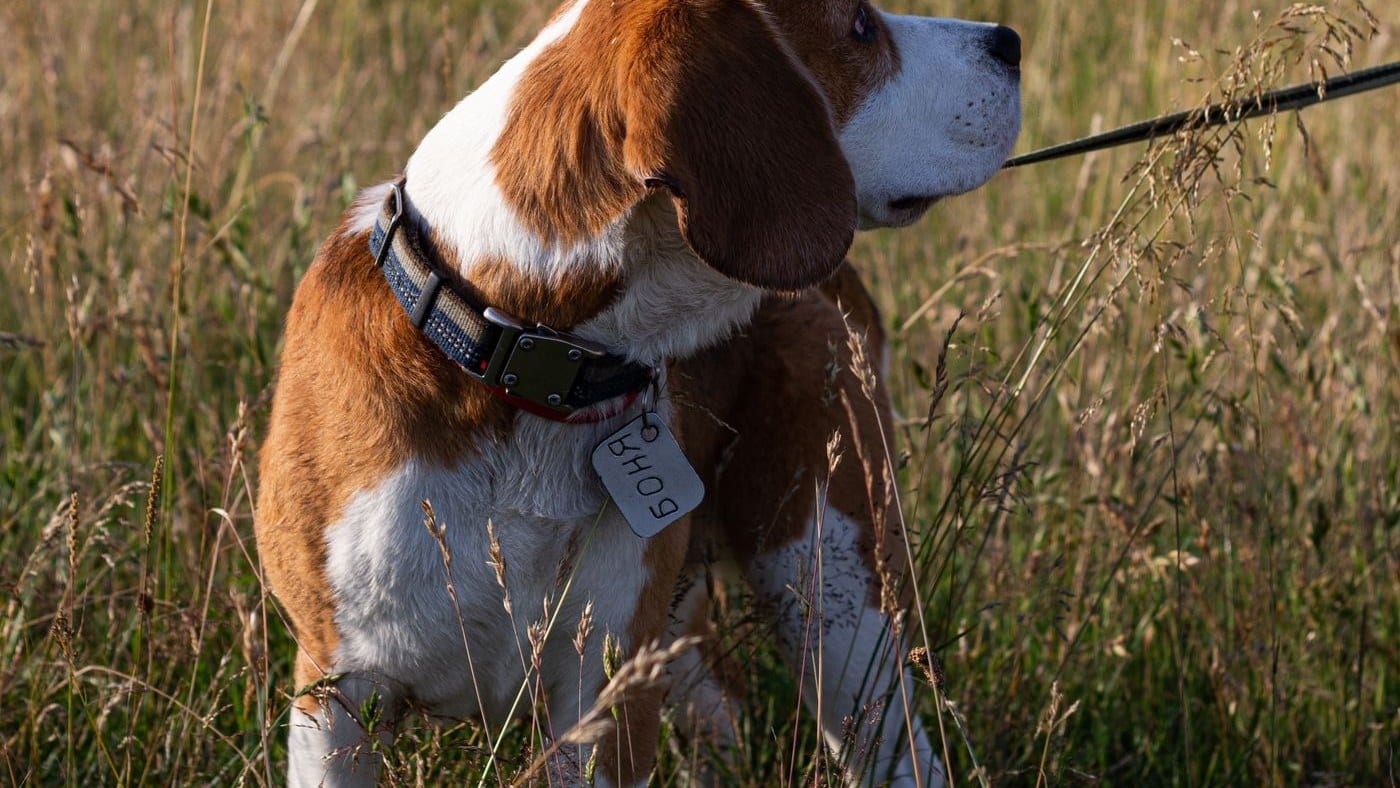
- Colour: most often tricolour (black, white, tan); two-colour variants are also permitted. The tip of the tail is always white — so the hunter can see it in undergrowth
- Lifespan: usually 12–15 years
How much exercise it needs
Count on an hour and a half a day, and above all on it being interesting. A Beagle needs to sniff — hunting for treats in grass occupies it more than kilometres of flat walking.
Free running only in a fenced garden. Off-lead work in a wood comes only when the owner is certain, and with this breed many owners never get there. That is not a training failure; it is a sensible precaution.
The fence has to be solid and dug in at the bottom — a Beagle will dig under, jump over and squeeze through.
Training and the first months
- Recall for food and for play, trained from puppyhood and never followed by telling the dog off for coming back late. A dog that gets scolded after being called comes back later still next time.
- Time alone, in minutes. A pack dog left on its own howls — and the neighbours find out before you do.
- Voice is part of the breed. The Beagle is loud, it barks, and on a scent it bays. In a flat with thin walls it is not an ideal dog.
- No feeding at the table. With this breed that is the start of a problem you will not then solve.
Feeding
An adult eats roughly 200–300 g of dry food a day in two meals. And here is the breed's biggest pitfall: a Beagle will eat anything, and keep eating.
Its appetite has no brake. It raids bins, picks things off the ground and opens cupboards. Obesity is one of the commonest diagnoses in Beagles and lies behind most of their later joint and back trouble.
Weigh the ration, count treats towards the daily amount and keep the bin shut. In this breed those are not tips, they are requirements.
Common health problems
- Obesity — the commonest problem in the breed and the one you can influence most.
- Outer ear infections — a long drop ear does not ventilate. Check and dry them.
- Intervertebral disc disease — in a long body on short legs, made worse by excess weight.
- Epilepsy — it occurs in the breed, usually showing as seizures between the first and fifth year.
- Hypothyroidism — an underactive thyroid; it shows as weight gain and deteriorating coat.
- Lens luxation and glaucoma — eye screening in breeding animals is worthwhile.
- Disc and hip problems in older dogs.
This is not a diagnostic guide. A dog losing or gaining weight, scratching at its ears or having a seizure belongs at the vet.
Anything else to consider
The Beagle sheds all year round, even with a short coat. And it has a stronger dog smell than most breeds — that is a characteristic, not a lack of cleanliness.
And expect noise. A Beagle’s bay carries a long way, and it is not a sound training can silence altogether.
Want one?
128 kennels here breed it. Each one has a contact and a link to its page.
Who breeds this
- ...vom SteinbrinkRinteln, Germany
- AlikissKunice, Czechia
- Alkin dvorTrhovište, Slovakia
- Angela's Honeysuckle BeaglesErkelenz, Germany
- BARDAPoland
- Beagle vom BiegenbachGeldersheim, Germany
- Beagle von der FestungsstadtPeitz, Germany
- Beagle von der Hansfelder MeuteUckerland, Germany
- Beagles von der HeidesiedlungWustermark-Elstal, Germany
- Beastie BeaglesBärnkopf, Austria
- Bórovska jobovicaMalé Borové, Slovakia
- Catweazle's DreamBonn, Germany
- Celine dvorBeckov, Slovakia
- Chequer'sAlveslohe, Germany
- Color JewelCzechia
- Cosmostar BeaglesLeegebruch, Germany
- Cuddling Cheek'sHamburg, Germany
- DarksanZlaté Moravce, Slovakia
- Diamond's TraceOlsberg, Germany
- DOUGLASSPoland
- Ekaterina Cubile FetaFiľakovo, Slovakia
- Emilion LakeKoprzywnica, Poland
- Erben KorwinsDürnau, Germany
- Everydays PleasureKirchlinteln, Germany
- Family-DelightPeine-Dungelbeck, Germany
- Finest SelectionSelfkant, Germany
- from Austrian WestsideFeldkirch, Austria
- From CornerhouseMärkisch Linden, Germany
- from Fairy's HeavenGelsenkirchen, Germany
- from Serada GardenHütschenhausen, Germany
- From Vivid's PackOersberg, Germany
- HAPPY BEAGLESPoland
- Hunter of ThuringiaRuhla, Germany
- Jil's DiamondsCzechia
- KING OF DOG'SPoland
- Kurinecká dubinaRimavské Janovce, Slovakia
- Łaciata Sfora FCIWarszawa-Wawer, Poland
- Legends of BeaglesSpannberg, Austria
- Lemon drops (VDH)Hilden, Germany
- LIŚCIASTY GAJPoland
- Little CarpathiansBučany, Slovakia
- Luck Devil'sEberswalde, Germany
- MAG.BEAGLEGraz, Austria
- MagicalicsHanerau-Hademarschen, Germany
- Memory of Tiffanys DiamondsBalve-Eisborn, Germany
- MOKRE USZYPoland
- My CoastluckSchwentinental, Germany
- My TreasureBorstel-Hohenraden, Germany
- New Impression'sDiepenau, Germany
- NICOŚPoland
- NOS KAMPINOSPoland
- Od Unínskeho potokaUnín, Slovakia
- Of Black Creek BeautiesKriftel, Germany
- Of Disney's ClanBergkamen, Germany
- of Grant's GardenRamsau am Dachstein, Austria
- of jack's connectionTribuswinkel, Austria
- Of Laurins EmpireHarztor, Germany
- of Pagatia's ClanStolberg, Germany
- Of Shepherd's Golden CircleHelmstadt, Germany
- Of Stonehedge MountainMiltenberg-Schippach, Germany
- Of Walk and WinSeeheim-Jugenheim, Germany
- Passionate TrackersLangen, Germany
- PIECHUŁAPoland
- PODNIEBNA POLANAPoland
- Potter's earth SnooperpackLauf an der Pegnitz, Germany
- RAINBOWPoland
- Sentimental Snowdancer'sSt. Oswald bei Plankenwarth, Austria
- SFORA SPOD MŁYNAPoland
- Simply SoxLangenzersdorf, Austria
- SŁONECZNA KRAINAPoland
- Sniffing SnoopyJablonec, Slovakia
- Snoopi Ellin von SchaftnachSchwabach, Germany
- Stormaway'sSonsbeck, Germany
- Sunny SideMokré Lazce, Czechia
- Sweet as a DreamDuisburg, Germany
- Sysou LionKomárno, Slovakia
- TADZIOWA ZGRAJAPoland
- TergyBzová, Czechia
- The Britain LegendNeuenburg, Germany
- the finest HeritageDorsten, Germany
- The Gift of NatureBielefeld, Germany
- The UnshakableBargteheide, Germany
- The VineyardguardSaulheim, Germany
- The Wonderful FairytaleBerlin, Germany
- Vienna CallingKirchberg am Wagram, Austria
- Vision of HarmonyBad Oeynhausen, Germany
- Vom Aje SeeRödermark, Germany
- Vom BliesgauKirkel, Germany
- vom BlümeltalSpielberg, Austria
- vom Brigittenauer ForstWien, Austria
- Vom Colditzer HeimatturmColditz, Germany
- vom DechelwaldGolling an der Salzach, Austria
- Vom DeistertalAuetal, Germany
- Vom EisbachtalWorms, Germany
- Vom Fahrländer SeeBerlin, Germany
- Vom Fürstenauer WaldOberzent, Germany
- vom Gerataler LandGeratskirchen, Germany
- Vom Kemnader SeeWitten, Germany
- vom Koblar SchlossbergKoblach, Austria
- Vom NordelmKönigslutter, Germany
Showing the first hundred. The rest are in the breeder directory.
Breeders by region
The number shows how many breeders in the region keep this breed.
- Nordrhein-Westfalen (Germany)17
- Niedersachsen (Germany)10
- Brandenburg (Germany)7
- mazowieckie (Poland)7
- Bayern (Germany)6
- Niederösterreich (Austria)6
- Schleswig-Holstein (Germany)6
- Hessen (Germany)5
- Steiermark (Austria)5
- Mecklenburg-Vorpommern (Germany)3
- Oberösterreich (Austria)3
- podkarpackie (Poland)3
- Rheinland-Pfalz (Germany)3
- Saarland (Germany)3
- Sachsen (Germany)3
- Banskobystrický kraj (Slovakia)2
- Berlin (Germany)2
- Košický kraj (Slovakia)2
- lubelskie (Poland)2
- Moravskoslezský kraj (Czechia)2
Breeders of this breed also keep
From the blog
- How to report animal crueltyA dog on a short chain with no water. A cat shut in an empty flat. Most people see something like this once and do not know who to call — and by the time they find out, they have talked themselves out of it. This guide is here so that does not happen.
- Adopting from a shelter: how it really worksFrom the first enquiry to the first week at home. Why the shelter asks so many questions, what a home check is for, and what to expect in the first three weeks.
- What the first year with a dog or cat really costsEveryone budgets for food and a bed. What breaks the budget is one item nobody expects — and costs that are not measured in money at all.